Learning Galois-Structured Representations of Natural Language

Michael Thomas

Furman University

December 8, 2025

Motivating Examples

  • Premise: “Two women are embracing while holding to go packages”
  • Hypothesis: “Two women are holding packages”
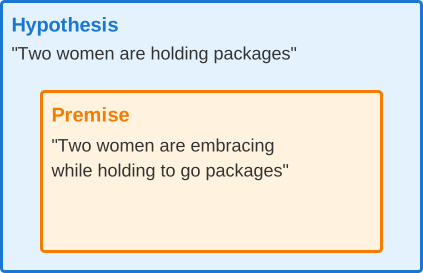
Relationship? → Entailment

  • Premise: “Two children in blue jerseys… in a bathroom washing hands”
  • Hypothesis: “Two kids at a ballgame wash their hands”
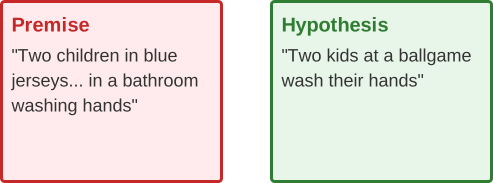
Relationship? → Contradiction

The Challenge

Central Problem: Representing sentence meaning for reasoning, composition, and interpretability

  • Neural language models (e.g., BERT) produce powerful distributed representations
  • But these embeddings lack explicit structure
  • Struggle to capture semantic relationships like entailment

Our Approach

Learn a Galois connection between natural language and structured geometric abstractions

  • Sentences → Boxes
  • Semantic entailment ↔︎ Geometric containment
  • Interpretable representations

What is a Galois Connection?

A Galois connection is a correspondence between two partially ordered domains
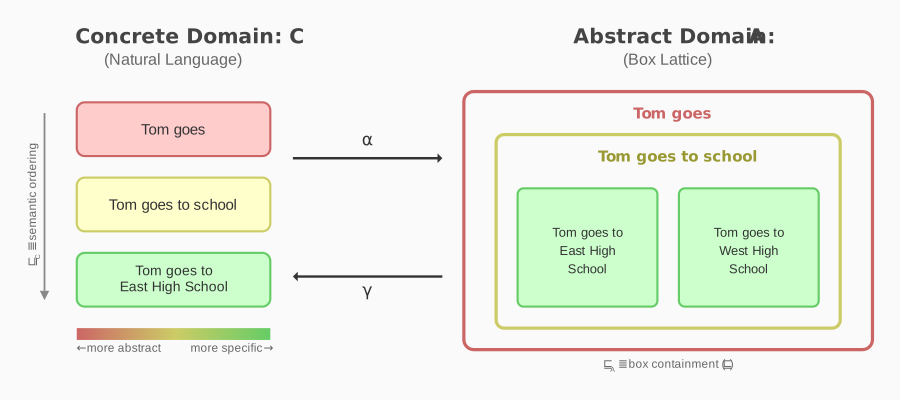
Abstraction (\(\alpha\)) maps sentences to boxes; Concretization (\(\gamma\)) reconstructs language

Natural Language Inference (NLI)

Task: Classify relationship between premise and hypothesis

  1. Entailment: Hypothesis logically follows from premise
    • Premise box ⊇ Hypothesis box
  2. Contradiction: Hypothesis conflicts with premise
    • Boxes are disjoint or violate containment ordering
  3. Neutral: No logical relationship
    • Partial or no overlap

Dataset: SNLI Corpus

Stanford Natural Language Inference

  • ~570,000 human-written English sentence pairs
  • Three balanced classes: Entailment, Contradiction, Neutral
  • Derived from image captions (Flickr 30k)
Premise Relation Hypothesis
two women are embracing while holding to go packages. entailment two woman are holding packages.
two women are embracing while holding to go packages. contradiction the sisters are hugging goodbye while holding to go packages after just eating lunch.
two women are embracing while holding to go packages. neutral the men are fighting outside a deli.

Model Architecture

Architecture Overview

  1. Abstraction Network (\(\alpha\)): BERT encoder → Box embeddings
    • Maps sentences to axis-aligned hyperrectangles \([l, u]\)
  1. Concretization Network (\(\gamma\)): Transformer decoder
    • Reconstructs natural language from boxes
  1. Box Lattice Operations: Geometric reasoning
    • Volume, intersection, containment violations
  1. Geometric Feature Classifier: 3-layer feedforward
    • 8 geometric features → Entailment/Contradiction/Neutral

Box Intersection Techniques

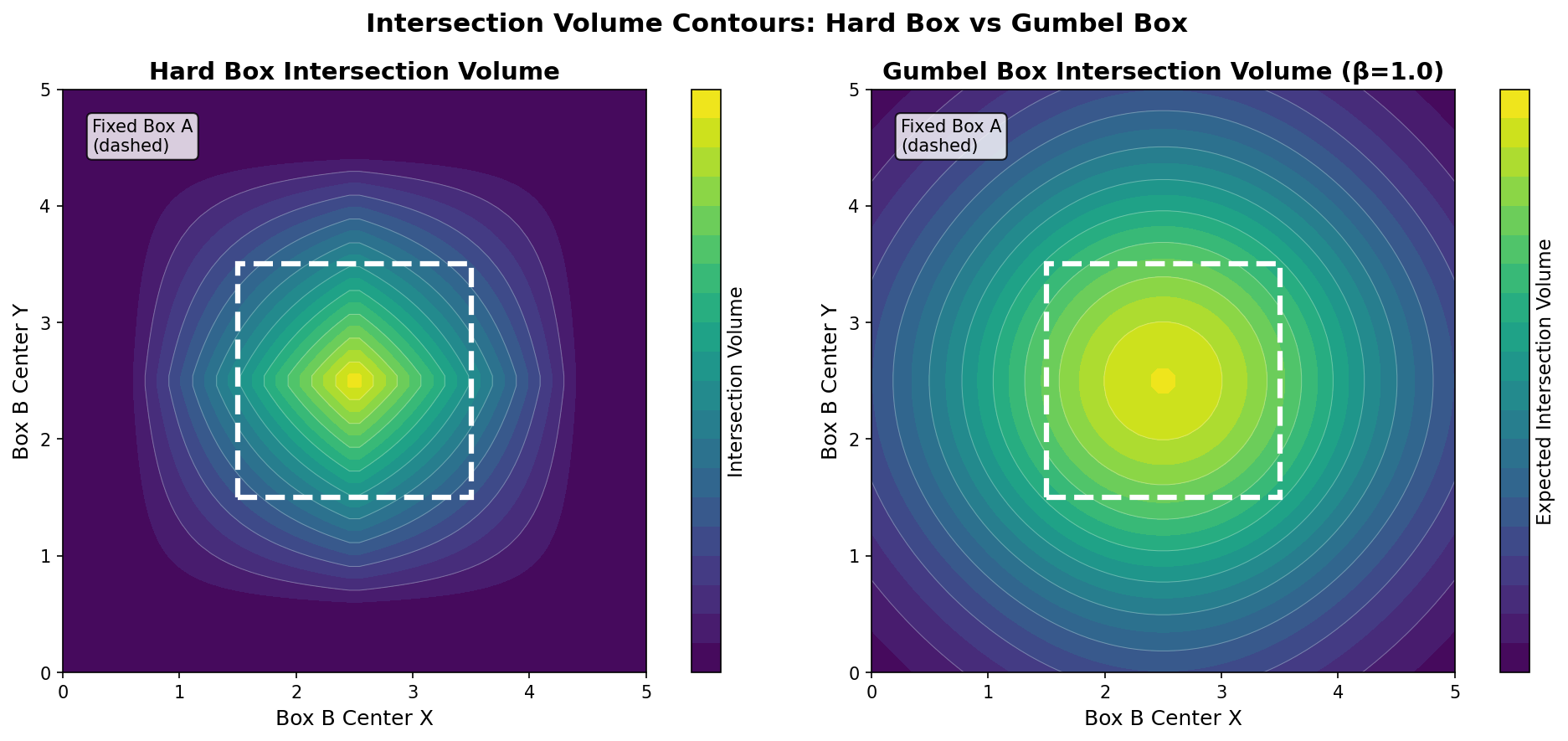
Hard vs. Probabilistic (Gumbel) intersection techniques

Soft [1] and Gumbel-smoothed [2] embeddings provide smoother gradients for optimization

Counterexample-Guided Abstraction Refinement

  • Maintains buffer of misclassified examples
  • Iteratively refines abstraction function
  • Example: If model wrongly infers “Tom goes” ⊆ “Tom goes to jail”
    • CEGAR detects counterexample
    • Penalizes incorrect box containment
    • Refines encoder to correct the relationship

Training Objective

Training aims to minimize the multi-component loss function:

\[ L = \lambda_{\text{recon}} L_{\text{recon}} + \lambda_{\text{Galois}} L_{\text{Galois}} + \lambda_{\text{task}} L_{\text{task}} + \lambda_{\text{CEGAR}} L_{\text{CEGAR}} + \lambda_{\text{reg}} L_{\text{reg}} \]

  • \(L_{recon}\): Reconstruction quality
  • \(L_{Galois}\): Geometric consistency
  • \(L_{task}\): NLI classification
  • \(L_{CEGAR}\): Refinement from counterexamples
  • \(L_{reg}\): Prevent excessive box growth

Results

Overall Performance

  • 80% validation accuracy on SNLI corpus
  • F1 score: 80% across all classes
  • Demonstrates viability of Galois connection framework
  • Semantic entailment successfully learned as geometric containment

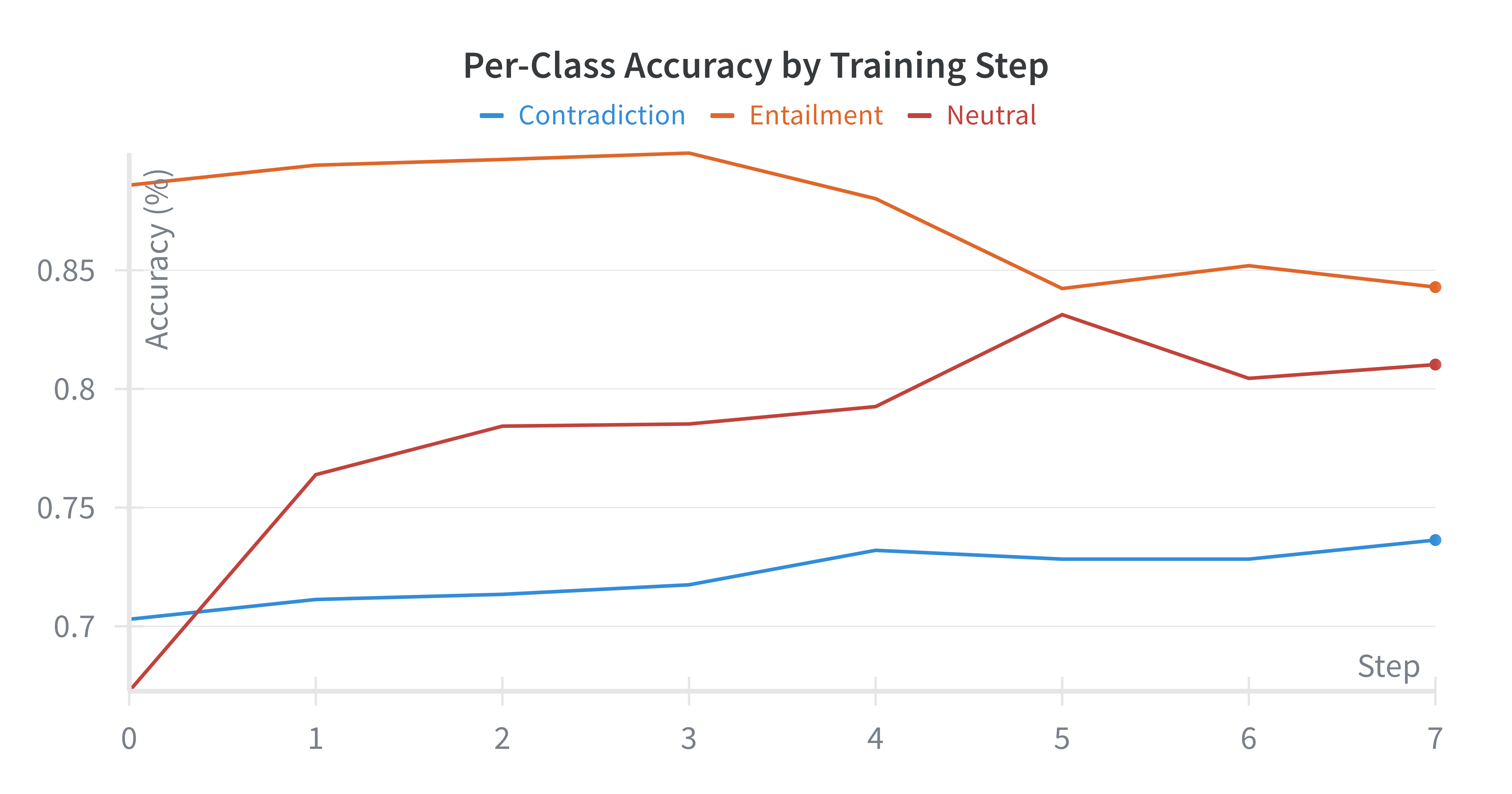
Per-Class Performance

  • Entailment learned first (straightforward geometric principle)
  • Neutral and Contradiction improve steadily
  • Challenge: Distinguishing subtle boundaries in shared geometric space

Reconstruction Quality
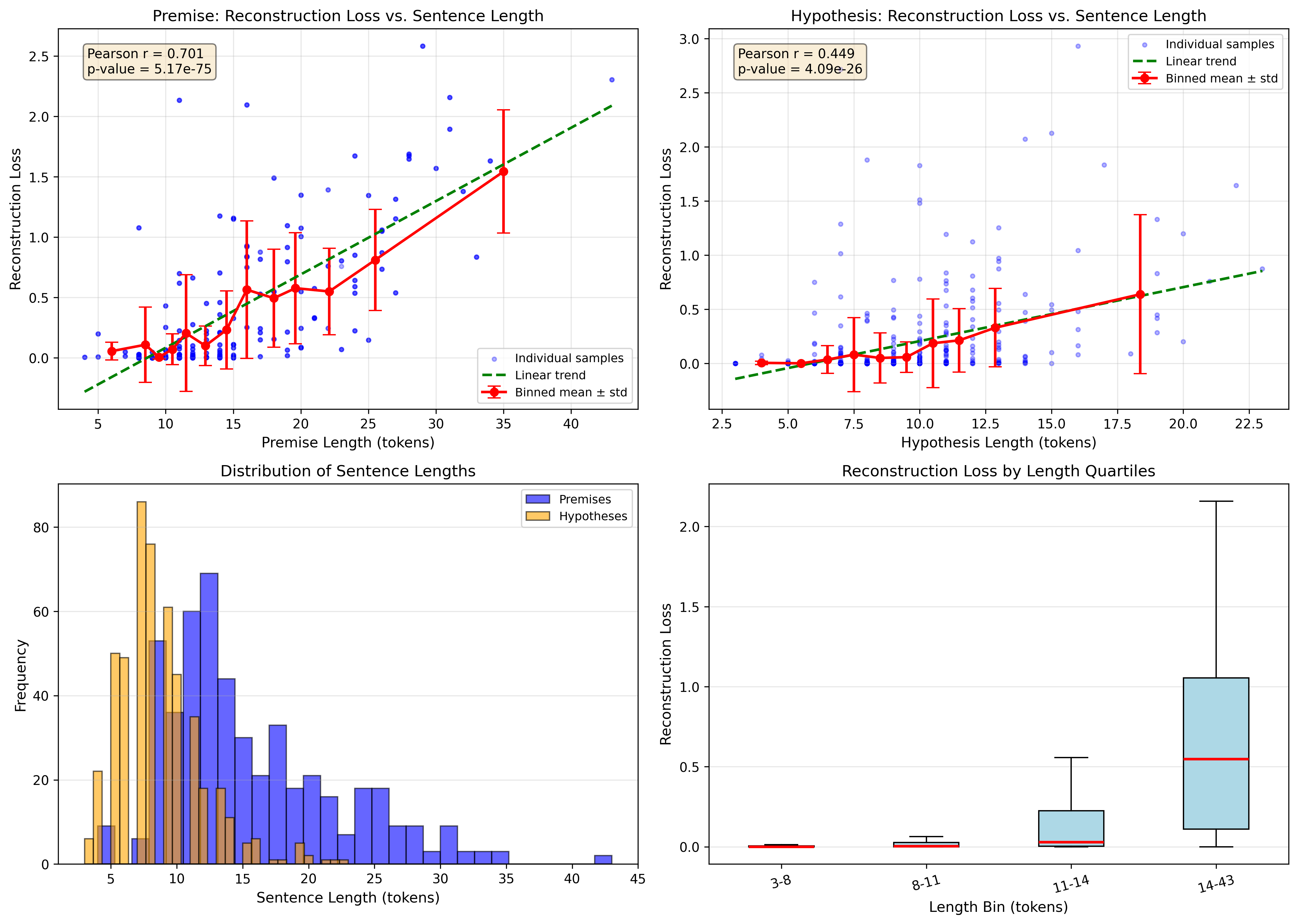
Strong correlation between phrase length and reconstruction loss (\(p < 0.001\))

  • Shorter phrases → Effective compression and reconstruction
  • Longer phrases → Information bottleneck in fixed-dimensional boxes

CEGAR Evaluation
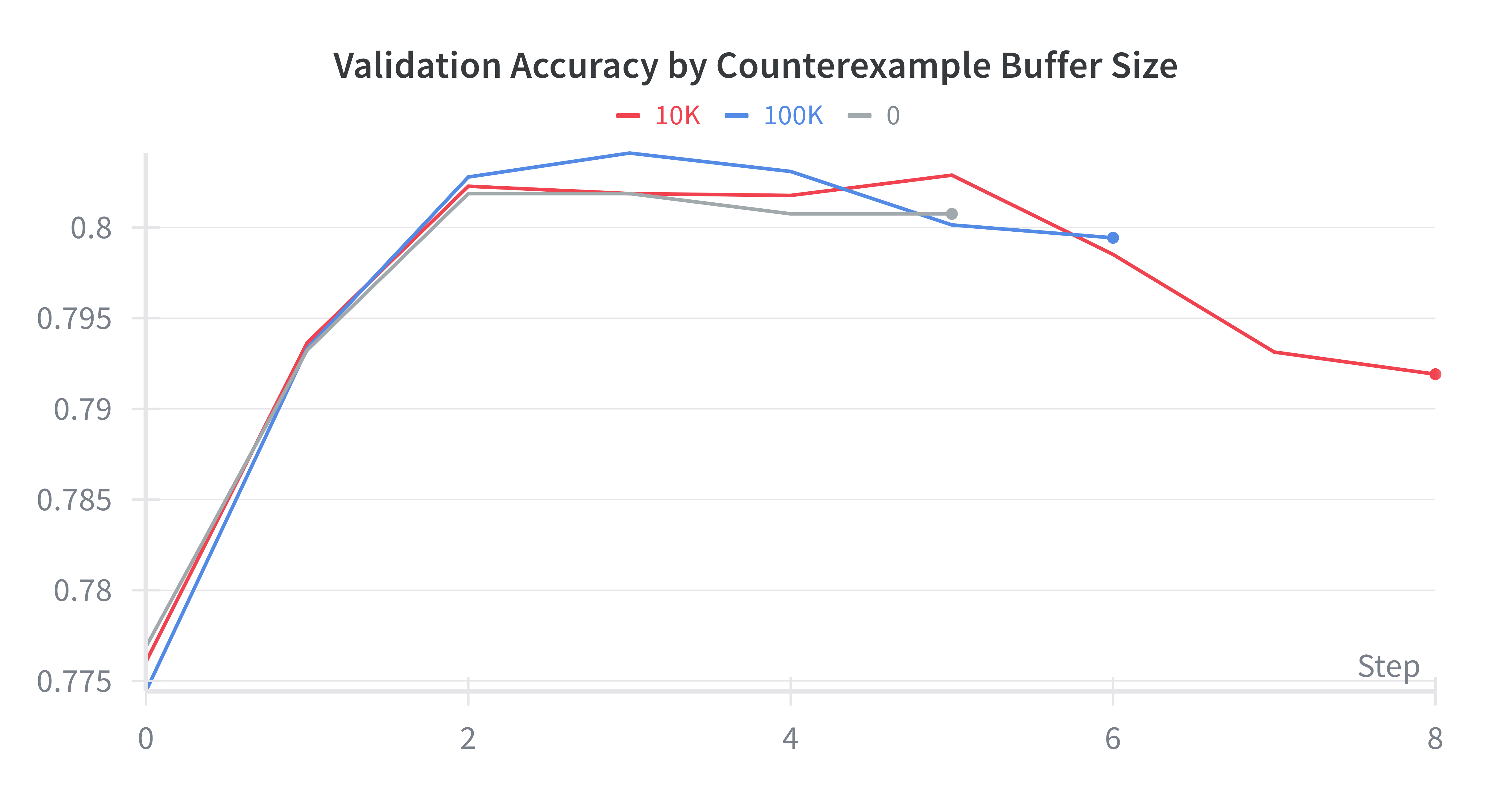
Unexpected Result: Buffer size had no significant impact on performance

  • All configurations converged to ~80% accuracy
  • Larger buffers introduced computational overhead
  • Future work needed on alternative refinement strategies

Example: Entailment

True Value Reconstructed/Predicted
Premise two women are embracing while holding to go packages. two women are embracing while holding to go packages.
Hypothesis two woman are holding packages. two woman are holding packages.
Label entailment entailment

Box representations successfully preserved semantic information

Example: Contradiction

True Value Reconstructed/Predicted
Premise two women are embracing while holding to go packages. two women are embracing while holding to go packages.
Hypothesis the sisters are hugging goodbye while holding to go packages after just eating lunch. the sisters are hugging after hugging while holding up to go lunch break.
Label contradiction contradiction

Specificity conflict identified, but longer hypothesis poorly reconstructed

Limitations

  1. Phrase Length Dependency
    • Fixed-dimensional boxes → information bottleneck
    • Longer phrases lose compositional complexity
  2. CEGAR Performance
    • No measurable improvement from counterexample buffer
    • Implementation vs. conceptual issues unclear
  3. Representational Capacity
    • Questions about box lattices for complex semantics

Key Contributions

  1. First end-to-end differentiable framework learning Galois connection for text

  2. Structured latent space as complete lattice of boxes

    • Interpretable, compositional abstractions
  3. CEGAR mechanism for iterative semantic refinement

  4. Integration of formal methods with deep learning

Future Directions

  1. Multiple Datasets: MultiNLI, SICK for generalizability

  2. Hyperparameter Optimization: Box dimensionality, loss weights, architecture choices

  3. Baseline Comparisons: SBERT, fine-tuned LLMs

  4. Interpretability Focus:

    • Replace neural classifier with decision trees
    • Visualization tools for high-dimensional box lattices
    • Alignment with human semantic intuitions

Conclusions

  • Abstract interpretation and representation learning can be combined for natural language understanding
  • Semantic relationships can be captured as geometric containment in structured space
  • Opens pathways for interpretable AI with formal guarantees
  • Further opportunities for research in representational capacity and refinement mechanisms

Thank You

Questions?

Michael Thomas
Department of Computer Science
Furman University

References

[1]
X. Li, L. Vilnis, D. Zhang, M. Boratko, and A. McCallum, “Smoothing the geometry of probabilistic box embeddings,” in International conference on learning representations, 2019. Available: https://openreview.net/forum?id=H1xSNiRcF7
[2]
S. S. Dasgupta, M. Boratko, D. Zhang, L. Vilnis, X. L. Li, and A. McCallum, “Improving local identifiability in probabilistic box embeddings,” arXiv preprint arXiv:2010.04831, 2020.